High temperatures can bring harmful algal blooms

When the summer sun shines and temperatures climb, conditions are ripe for Minnesota lakes to produce harmful algal blooms. Most algae are harmless, but under the right conditions, certain types of algae can pose health risks. People or animals may become sick if they come into contact with or ingest affected water. In extreme cases, dogs and other animals have died after exposure to lake water containing toxic blue-green algae.

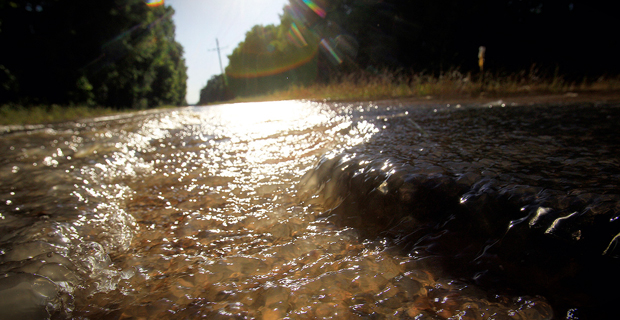
High rainfall results in nutrient-rich runoff entering our lakes, which fuels algae growth. As sunlight increases and temperatures warm, we can anticipate blooms of blue-green algae on many of our lakes,” said Minnesota Pollution Control Agency (MPCA) lakes expert Steve Heiskary.

There are many types of blue-green algae found everywhere, but thrive particularly in warm, shallow, nutrient-rich lakes and ponds. Often blown toward downwind shorelines, it is under these conditions that humans and animals come in contact with blue-green algae and where the risk of algal toxins is greatest.

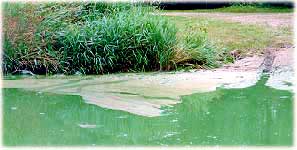
Not all blue-green algae are toxic, and there is no visual way to predict whether a blue-green algal bloom contains toxins harmful to humans or animals. But harmful blooms are sometimes said to look like pea soup, green paint, or floating mats of scum, and they often have a bad odor. “You don’t have to be an expert to recognize an algae bloom that might be harmful,” Heiskary said. “If it looks bad and smells bad, don’t take a chance. Stay out, and keep children and pets away from the water until the bloom subsides.

For more information about harmful algae blooms see the MPCA Blue Green Algae fact sheet or call the MPCA at 651-296-6300.

If experiencing health effects, contact a medical professional. In addition, people are encouraged to report human health effects to the Minnesota Department of Health (MDH) Foodborne Illness Hotline (monitors all disease outbreaks) at 1-877-366-3455. For health questions, citizens can contact MDH’s Acute Disease Investigation and Control group at 651-201-5414 or visit the MDH’s Blue-green Algal Bloom web page.

Master Naturalist Training at Anoka Ramsey Community College (Fall 2012)

If you enjoy hiking, bird watching, following tracks, or identifying wildflowers, you’ll love being a Minnesota Master Naturalist Volunteer. Minnesota Master Naturalist Volunteers are a motivated group of fun and interesting people: retired professionals, nature guides, hunters, eco-tour operators, farmers, and Anoka County residents!

This training is part of a Field Biology course of the north woods and great lakes at the Anoka Ramsey Community College that will meet on Mondays 2:00 to 4:40 p.m. from August 27th to December 17th with a field trip on 9/29 (8:30 a.m. to 5:00 p.m.).  Class topics include: geology, plants, wildlife, ecology, water, communication and human impacts on our natural environment.  There are 6 openings for non credit students (cost $200) to register for this class.

The mission of the Minnesota Master Naturalist program is to promote awareness, understanding, and stewardship of Minnesota’s natural environment by developing a corps of well-informed citizen volunteers dedicated to conservation education and service within their communities.

For class information contact: Jennifer Braido (jennifer.braido@anokaramsey.edu) 763-433-1219.

For Minnesota Master Naturalist program information go to the contact webpage; email info@minnesotamasternaturalist.org; or call 888-241-4532.

Rain Barrel and Compost Bin Sale in Coon Rapids (order on-line / pick-up June 16th)

The City of Coon Rapids is sponsoring Recycling Association of Minnesota’s (RAM) Rain Barrel and Compost Bin Sale.

During a one-inch rain event 0.6 gallons of water will fall on a square foot of roof and 54 gallons will fall on 90 square feet of roof—enough to fill a 55 gallon rain barrel.

Benefits of Rain Barrels

  • They provide an alternative to tap water for watering lawns and flower gardens.
  • They will help reduce peak volume and velocity of stormwater runoff reaching lakes and rivers.
  • They will help reduce peak water demands during the summer months.
  • Rainwater can actually help improve the health of your gardens, lawn and trees.  Rainwater is naturally “soft” and devoid of minerals, chlorine and other chemicals found in city water.
  • Water Conservation

Benefits of Composting –  Through backyard composting, you can recycle fruit scraps, vegetable peelings, grass and leaves into a wonderful soil amendment called humus.

  • Enjoy healthier plants! Compost can be spread on your lawn, as top dressing, or placed around plants, bushes and trees as a mulch to help retain moisture and inhibit weed growth.
  • Reduce your garbage! Remove the organic material from your garbage and you may be able to have a smaller garbage can.  Conserve water! Placing compost around plants, bushes and trees will help retain moisture so you won’t have to water as much.
  • Composting your food waste means you don’t have to use your garbage disposal and the extra water it takes to flush it down your drain.

RAM is taking pre-orders on selected of Rain Barrels and Compost Bins for you to pick up at the Coon Rapids Recycling Center (1831 – 111th Avenue NW, Coon Rapids) on Monday, June 16th.  Order are accepted from now until sold out.  Hurry, while supplies last!

PLEASE NOTE: You must pick up your order on June 16, 2012!  These are the only dates available to get your order.  If cannot arrange for your order to be picked up on these dates, please DO NOT place an order.

For more information contact Recycling Association of Minnesota (852B East Lake Street – Wayzata, MN  55391 / Phone: 952-473-0048 / Email: ram@recycleminnesota.org)

Rice Creek Watershed – best management practices cost-share grants available

Landowners and businesses in the Rice Creek Watershed District interested in protecting and improving surface water quality are not alone.  The RCWD has created a dedicated cost-share grant program to assist landowners with the implementation of Best Management Practices (BMPs) aimed at improving the quality of surface waters within the District. Installing a raingarden, stabilizing erosion problems along your shoreline, and restoring degraded wetlands are some of the practices that may be eligible for this program. The RCWD may provide funding up to 50% of total project costs up to a maximum of $5,000.

Anoka Conservation District has partnered with RCWD to provide technical assistance to landowners in Anoka Counties. For more information, please contact Nate Zwonitzer, Conservation Technician (763-434-2030 x11).

Attention anglers and boaters: help control aquatic invasive species

The Minnesota Department of Natural resources is stepping up patrols and citations ($50 – $1,000) for violating the state’s aquatic invasive species (AIS) laws.  Invasive species are species that are not native to Minnesota and cause economic or environmental harm or harm to human health.

In addition to the many lake associations in Anoka County – two Lake Improvement Districts have been established for Lake George and Coon Lake.  The purpose of these lake organizations is to maintain the quality of the lake and shore environment which includes preventing and controlling aquatic invasive species.  PLEASE DO YOUR PART!

For more information on AIS and how you can prevent their spread visit DNR’s Aquatic Invative Species website or contact the DNR’s AIS Specialist, Keegan Lund, at 651-259-5828.

MDH Summer Waterline Newsletter

The Summer 2012 Waterline Newsletter (for water operators and others interested in news related to public water systems) is available including part 3 of High Hazard Cross-Connection -a significant deficiency.

Wellhead Protection Public Meetings

The Anoka County Municipal Wellhead Protection Group has held two area meetings to ask residents and businesses near municipal water supply wells to use best management practices to prevent pollution of the soils and groundwater.

The area meetings were held:

  • February 15th at Circle Pines City Hall (for Centerville, Circle Pines, Lexington and Lino Lakes)
  • March 14th at Blaine City Hall (for Blaine, Fridley and Spring Lake Park)

Wellhead Protection is a program to protect the source of water to public wells.  Residents and businesses within a wellhead protection area (near a public water well) can contribute to the safety of drinking water for their community.   Properties that are partially or entirely within a wellhead protection area are designated to be in the Drinking Water Supply Management Area (DWSMA).  Use the DWSMA Map App to find out if a property is inside a DWSMA.

Best management practices materials provided to attendees included

Wellhead Guide for Residents  –  Wellhead Guide for Businesses

Financial Assistance for Well and Septic Repair – Directory of Well Contractors

CITY WELLHEAD FACT SHEETS:

Blaine  –  Centerville  –  Circle Pines  –  Fridley  –  Lexington  –  Lino Lakes  –  Spring Lake Park


Anoka County Compost Sites are Open

Anoka County Compost Sites are open to accept resident’s yard waste.  Locations, hours and a small fee is listed on the Compost Sites page.  For more information contact Integrated Waste at 763-323-5731.

National Ground Water Awareness Week (March 11-17, 2012)

Anoka County Municipal Wellhead Protection Group celebrates National Groundwater Awareness Week (March 11-17, 2012).  Groundwater is a valuable asset to the health and vitality of our community.

We rely on groundwater to provide safe drinking water to our families.  Over 300,000 people in Anoka County get their drinking water from the groundwater wells of 259 public water systems (e.g. municipal, mobile home parks, schools, etc.) or private home wells.

Test your home well every year or contact your public water supplier for a copy of your drinking water report.

Residents and Businesses  – prevent pollution of soils and groundwater.

Minnesota’s largest sealcoater switches to safer formula

Coal-tar residues that can contaminate stormwater ponds may become a thing of the past thanks to a voluntary phase-out by Eagan-based Jet-Black International, one of the nation’s larger franchisers of pavement seal-coating services.

Read more in this press release from the Minnesota Pollution Control Agency:  http://www.pca.state.mn.us/aj0r1085

Powered by WordPress