2013 Anoka Co. Conservationist and Educator of the Year

(UPDATE 11/15/2013) St. Francis High School teacher DC Randle has been selected as the 2013 recipient of the Minnesota Association of Soil and Water Conservation Districts (MASWCD) Teacher Award. The MASWCD recognizes outstanding teachers of natural resource conservation. The Anoka Conservation District nominated Randle for the award, which he will receive at the MASWCD Awards Luncheon on December 2. Congratulation DC Randel!

(10/30/2013) The Anoka Conservation District selected the Coon Creek Watershed District as the 2013 Anoka County Outstanding Conservationist. The CCWD will be honored at the MASWCD annual convention as well.

The Coon Creek Watershed District has simultaneously taken the lead in a watershed restoration and protection project, completed multiple stormwater retrofit assessments and installed large numbers of practices. They have acted with urgency and a bold “let’s just get it done” attitude. Their recent and ongoing work has included five stormwater retrofit assessments, two stormwater pond modifications, one new stormwater pond and 20+ rain gardens.

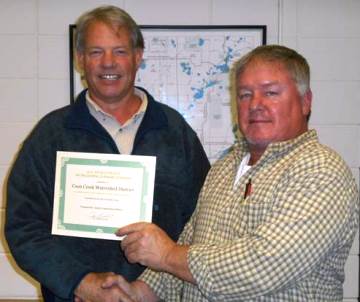
[Pictured: Anoka Conservation District Vice Chair, Jim Lindahl, presents Conservationist of the Year certificate to Coon Creek Board President, Byron Westlund.] For more information on the program, contact Anoka Conservation District Manager Chris Lord at 763-434-2030.

There is no such thing as 100% safe

Cold facts about ice safety

Thinking about going onto the ice? Check out the MN Dept of Natural Resources video: Danger Thin Ice.

New ice is usually stronger than old ice. Four inches of clear, newly‑formed ice may support one person on foot, while a foot or more of old, partially‑thawed ice may not.

Ice seldom freezes uniformly. It may be a foot thick in one location and only an inch or two just a few feet away.

Ice formed over flowing water and currents is often dangerous. This is especially true near streams, bridges and culverts. Also, the ice on outside river bends is usually weaker due to the undermining effects of the faster current.

The insulating effect of snow slows down the freezing process. The extra weight also reduces how much weight the ice sheet can support. Also, ice near shore can be weaker than ice that is farther out.

Booming and cracking ice isn’t necessarily dangerous. It only means that the ice is expanding and contracting as the temperature changes.

Schools of fish or flocks of waterfowl can also adversely affect the relative safety of ice. The movement of fish can bring warm water up from the bottom of the lake. In the past, this has opened holes in the ice causing snowmobiles and cars to break through.

For more information on ice safety contact the Minnesota Department of Natural Resources at (651) 296-6157 (or email the Information Center at info.dnr@state.mn.us) and ask for their free ice safety publications. Outside the metro area 1-888-646-6367

Hope Free Lutheran Church receives a drinking water protection grant

Update (12/4/2013) A little snow doesn’t stop Minnesota well contractors from constructing a reliable well that will serve Hope Free Lutheran Church with safe drinking water. Congratulations to the church leaders that found a way to improve their building as they improve the services that are available to the congregation.

(11/10/2013) Hope Free Lutheran Church (Columbus, MN) has been informed that their application for a Source Water Protection grant has been approved by the Minnesota Department of Health (MDH). With this grant the shallow well, constructed in 1965, will be replaced with a modern well that will provide reliable, safe drinking water to the church community for many years. MDH Source Water Protection Grants provide financial assistant to each category of public water suppliers based on their needs and priority for protection of the public drinking water supply.

Noncommunity transient public water supply systems, like Hope Lutheran Church, are encouraged to apply for a grant that is needed to improve the protection and quality of their drinking water supply. The MDH will accept new grant applications from Noncommunity Transient Public Water Supplies (grant information webpage) during the month of March 2014. For more information contact the MDH Drinking Water Protection Program at 651-201-4700 (health.drinkingwater@state.mn.us).

Comments invited on the Minnesota Strategic Plan for Groundwater Management

(UPDATE 11/5/2013) Today, the U.S. Environmental Protection Agency has released a report on the Importance of Water to the U.S. Economy (PDF, 37 pp, 2MB). The report highlights water’s importance to our national economic welfare, and summarizes information necessary to understand and manage water resources.

The Minnesota Department of Natural Resources (DNR) has released their Draft Groundwater Strategic Plan (GWSP) to achieve the goal of sustainable groundwater use. The DNR has announced that a North & East Metro Pilot Groundwater Management Area (including part or all of Anoka County) will be designated an initial Groundwater Management Area for implementation of the strategies established in the draft GWSP. Proposed strategies include:

  • Improve information about our groundwater resources;
  • reinforce partnerships to provide better support for sustainable groundwater use;
  • improve compliance with existing groundwater regulations;
  • assure that permits for large water appropriations provide sustainable supplies of groundwater for future generations; and
  • concentrate action in areas of high groundwater use and/or limited groundwater supply.

After reviewing the DNR Strategic Plan, the public is invited to comment by taking a survey.

Conservation Corps Minnesota accepting applications for 2014

The Conservation Corps Minnesota and Iowa is taking applications from young adults, ages 18 to 25, for 160 crew member and leader positions in the 2014 program year. Positions are available statewide, as well as central Iowa. Priority application deadline is Dec. 4.

All projects are completed on public land in cooperation with nonprofit organizations and government agencies, such as the Minnesota Department of Natural Resources (DNR). These opportunities provide technical field experience and professional certifications for future natural resource careers. Many natural resources professionals got their start with the Conservation Corps (formerly MCC).

Corps members receive on-the-job training in natural resource management and put those skills into practice working on habitat restoration projects throughout the Midwest. Crew members receive a living stipend of $1,210 a month (crew leaders: $1,565 a month), health insurance, student loan forbearance during the service term and a post-service AmeriCorps Education Award that may be used for college expenses or to repay qualified student loans.

To apply for the field crew program, and to view other AmeriCorps positions with Conservation Corps, visit www.conservationcorps.org/apply or contact Mark van der Linden, recruitment coordinator for more information at mark@conservationcorps.org or 651-209-9900, ext. 31.

Protecting groundwater quality is a matter of pollution prevention

Clean groundwater is vital. Groundwater not only provides drinking water to most Anoka County residents and businesses but it provides the necessary water for the operation of all plumbing fixtures (e.g. showers, toilets, kitchen faucets, etc.) It also irrigates crops and lawns, maintains water levels in lakes, and (given enough time) can assimilate some pollution.

Polluted groundwater often is unsuitable for drinking and usually expensive to clean up. Plus, it also costs more to construct a water-supply well in an area of polluted groundwater since the well may need to be drilled deeper to tap an uncontaminated aquifer, where available.

The Minnesota Pollution Control Agency has released a Report The Condition of Minnesota’s Groundwater, 2007-2011 (Aug. 2013) describing the condition of Minnesota’s groundwater including trends of selected contaminants. The Report emphasizes that the quality of water, in heavily-used aquifers, is vulnerable to pollution.

Assessed are the impacts of nitrate, phosphorus, sulfate, chloride, arsenic, iron, manganese, a suite of 68 volatile organic compounds (VOCs), and a suite of over 100 contaminants of emerging concern (CECs) on groundwater. The water-quality assessments were primarily based on chemical monitoring data collected from 2007-2011.

For information on how to prevent pollution and protect Anoka County’s groundwater:

Cedar Creek is the center of an ecosystem study from above

A multi-institutional research effort centered at Cedar Creek Ecosystem Science Reserve (East Bethel, MN) will seek answers about plant biodiversity and trends in ecosystems.  The project is titled Linking remotely sensed optical diversity to genetic, phylogenetic and functional diversity to predict ecosystem processes. 

Tracking changes in biodiversity over time is key to maintaining vital ecosystem processes that support: carbon storage, healthy streams, rivers and lakes, and clean drinking water.

This project will measure biodiversity from the sky by remotely sensing the reflected light spectra of plants and investigate the consequences of biodiversity for ecosystem and global processes. The study will test whether plant diversity can be detected remotely from the air and from space.  Project scientists from four institutions will investigate linkages between plant biodiversity, soil microbe diversity and ecosystem function. These efforts will serve in the development of airborne and satellite platforms that can routinely monitor biodiversity and identify trends in ecosystems.

The project seeks to transform methods for detecting changes in biodiversity worldwide and will provide numerous training opportunities in science, technology and math (STEM) for young scientists. Results will be integrated into the Cedar Creek Schoolyard Ecology program. Citizen scientists will be engaged through the MN Phenology Network. Data and research outcomes will be archived in publicly accessible data repositories.

Mississippi River nutrient reduction strategy

MissRivHypoxiaMap (MPCA)Water is among Anoka County’s most valued natural resource. Anoka County is part of the Mississippi River watershed. In the Land of 10,000 Lakes, Minnesota’s tourism and economy depend on healthy waters that provide recreational opportunities, safe drinking water, productive agriculture, healthy fish and wildlife habitat.

The goal for Minnesota water is to be fishable and swimmable for residents and those that come to visit. However, fishable and swimmable isn’t always possible due to excessive levels of nutrients entering our waters from a variety of activities on the land. See Nutrient Pollution (a 90 second video). When we have nutrient problems in our creeks and streams, they can flow into the Mississippi and eventually flow downstream to people in other cities and states who need clean water, too.

Many states and communities that share the Mississippi are facing significant water quality issues. The accumulation of nutrients is most prominent in the Gulf of Mexico. The Gulf is facing extreme low dissolved oxygen leading to a condition known as hypoxia (low oxygen).

Each of the 12 states contributing to the hypoxic conditions in the Gulf of Mexico, and participating on the Hypoxia Task Force, have agreed to develop strategies by 2013. The draft Minnesota Nutrient Reduction Strategy is now available for public review and comment through December 18, 2013. The conversation begun during this comment period will be integrated to strengthen the recommendations contained in the strategy. Once finalized, this initial iteration of the Strategy will serve as a guide for the reduction of nutrients throughout Minnesota.

Homeowners: You can prevent nutrients from polluting surface waters by following directions when applying lawn/garden fertilizers and keeping pet waste out of creeks, ditches and storm drains. See 15 Ways to reduce nutrients in lakes and streams.

Building Services and Public Works Directors: The Minnesota Extension Service – Stormwater Education Program is holding a workshop on “Planning to Reduce Nutrient Loading through Street Sweeping.” You are invited to attend the 2 1/2 hour workshop (8:00 to 10:30 am) being held on November 12th or November 21st .  For more information contact the Extention Service Stormwater Education Program (651-480-7732).

Outdoor stockpile management: get ready for fall and winter

It’s common to find materials stockpiled outside including:

  • Auto parts in salvage yards
  • Appliances, electronics and drums at solid waste facilities
  • Lumber at sawmills, flooring mills or wood-preserving facilities
  • Sand or de-icing salt at building/road maintenance facilities
  • Topsoil/soil/gravel from excavations at sand and gravel facilities

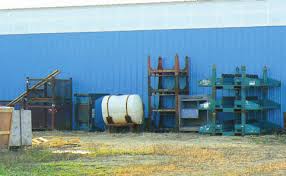
If your facility stockpiles these or similar raw materials, proper management is necessary to prevent stormwater from washing across the exposed stockpile, becoming contaminated and carrying particulates and contamination off the facility property.

Some of the easiest practices to implement can be the most effective in managing any type of raw material stockpile:

  • Impermeable berms or channels located ‘upstream’ to route surface flows away from the stockpiled material
  • Berming the stockpile on all sides with a ramp for truck and equipment access
  • Curbing along the perimeter of the area to prevent the run-on of uncontaminated stormwater from adjacent areas as well as runoff of stormwater from the stockpile areas
  • Covering small stockpiles at all times when work with the stockpiles is not occurring
  • If the stockpiles are so large that they cannot feasibly be covered and contained, implement erosion control practices at the perimeter of your site and at any catch basins to prevent erosion of the stockpiled material off-site

For more information go to the Minnesota Pollution Control Agency’s Industrial Stormwater Program webpage or call the MPCA at 651-296-6300.

Guidelines for drinking water protection at seasonal establishments and events

As the temperature drops people move inside leaving cabins, golf courses, water parks and baseball diamonds empty until spring.  It also means closing up seasonal wells and water dispensers at parks, campgrounds, golf courses and outdoor catered events.

Anoka County Community Health and Environmental Services Department encourages operators of seasonal water well systems and on-site water dispensers to properly close wells and store dispensers by following the Department guidelines:

Guidelines for Opening & Closing Seasonal Well Water Systems

Guidelines for Drinking Water Dispensers

For more information call 763-422-7063.

Powered by WordPress