So, you think you know your property. Do you have an old well?

Many Anoka County residents and businesses would be surprised to learn that an old well is hidden or buried in the basement or on their property. Old wells that have not been properly sealed become a serious hazard to the quality of groundwater and the safety of the community’s drinking water supply. Minnesota law requires the owner of an unused well to have it sealed. Minnesota law requires the seller of a property to disclose all wells on the property.

Priority: sealing old wells near city wells. Public water suppliers in Anoka, Blaine, Centerville, Circle Pines, Fridley, Lexington, St. Francis and Spring Lake Park have performed Well Probability Studies of the Wellhead Protection Area around their wells.

A property is probable to have a well if a home or building was constructed before public water was available. When city water reached the home the well was often abandoned, forgotten and lost. But it remains a way for pollution to flow down the old decayed pipe into the source of water to the community – unless it is sealed correctly (by a licensed well professional).

The results of the Well Probability Studies have been incorporated into the Anoka County Wellhead Protection website. By selecting the “Probable Well Parcels” checkbox from the “More” tab the property lines with probable wells are highlighted. When clicking on the property you will see the year that the building was constructed and the year water main service was installed.

DWSMA Map App 02

Help is available. Your city is ready to help residents in complying with the laws to seal wells and protect groundwater. Grants to seal old wells within wellhead protection areas are currently available (for a limited time) from Blaine, Circle Pines, Fridley, Lexington and Lino Lakes. All cities are interested in hearing from residents about wells and are finding ways to assist property owner in sealing their well.

For more information, or be notified of future grants, contact the wellhead protection manager in your city:

  • Andover: Brian Kraabel 763-767-5180
  • Anoka: Pete Klingenberg 763-576-2923
  • Blaine*: Jim Hafner 763-785-6188
  • Centerville: Paul Palzer 651-429-4750
  • Circle Pines* : Chandra Peterson 763-231-2611
  • Coon Rapids: Kory Jorgensen 763-767-6493
  • Fridley*: Jim Kosluchar 763-572-3566
  • Lexington*: Bill Petracek 763-354-2805
  • Lino Lakes*: Marty Asleson 651-982-2435
  • Ramsey: John Nelson 763-433-9861
  • St. Francis: Paul Teicher 763-753-2630
  • Spring Lake Park: Terry Randall 763-784-6491

*Well Sealing Grants are currently available. The well must be sealed by April 15, 2016. Please hurry.

4th grade teachers! – register for the metro area childen’s water fest

Each year over 1,200 fourth-grade students have attended the annual Metro Area Children’s Water Festival since 1998. That’s over 21,000 students that participated in this unique education program. It may seem like a drop in the 4th-grade lake – but that drop creates ripples around the twin-cities and changes in tomorrow’s citizen’s about our local water resources.

CWF is taking registrations to draw 4th grade classrooms from around the Twin Cities. Teachers are encouraged to submit a registration form  by March 31, 2016 to be included in a metro-wide drawing of 4th grade classes. There is no charge to the schools/classes.

For more information, check out the Metro Area Children’s Water Festival website: http://metrocwf.org/.

Metro Area Children's Water Festival ("Fish Prints" Arcade Photo)

Use water wisely poster contest

H2O4Life Poster ContestAnnouncing the Use Water Wisely Poster Contest.  The H2O for Life/Race 2 Reduce organization has an opportunity for students to use their talent to encourage wise us of our water resources. Learn about the issue, make a poster, and enter to win a prize as well as community recognition of your talent/message.

All entries must be postmarked or delivered to H2O for Life by March 4th, 2016.

The purpose of this poster contest is to provide you an opportunity to learn about actions your community can take to use water wisely. Utilize your creative talent to illustrate the importance of our water resources and how we can be good stewards of our water. Posters could emphasize water conservation and ideas for saving water within the community, drinking from the tap instead of the bottle, minimizing pollution of water resources, or another theme. See the official guidelines and rules at www.H2OFORLIFESCHOOLS.org for more information.

Prizes. Grand Prize Winner will receive a water bottle filling station for their school (valued at over $1,500) and a $50 prize. Installation of water bottle filling station is the responsibility of the winner/school. Category Winners will receive a $50 prize. Categories are as follows: Elementary (grades K-5), Middle School (grades 6-8), High School (grades 9-12)

H2O for Life, the Minnesota Department of Health, Xcel Energy, Elkay, and the Minnesota Section of the American Water Works Association are sponsoring the poster contest for Minnesota K-12 students, encouraging people to use water wisely.

H2O for Life
“Poster Contest”
1310 E. Hwy 96 Suite 235
White Bear Lake, MN 55110

If you have questions or for further information, please contact Sarah Alexander, H2O for Life at 651-756-7577.

Avoiding Lead Contamination in Water

Public water supply systems have been involved in monitoring water within households since the implementation of the federal Lead and Copper Rule in the early 1990s. Lead is rarely present in drinking water at its source (groundwater or rivers).  Instead, it works its way into water through connections, plumbing and fixtures – containing lead – on the way to the faucet.

While Anoka County (and Minnesota) communities have had relatively few issues with lead contamination, a number of U.S. cities have had prominent lead contamination problems in recent years.

Problems Elsewhere. A change in chemical treatment had a major effect in Washington, D. C., in the early 2000s, causing corrosion in pipes and the subsequent discovery of lead levels in the city residents’ drinking water.  In 2014 the City of Flint, Michigan, temporarily switched its water source from Lake Huron to the Flint River.  Flint treated the river water to make it safe, but the water reaching people’s homes was corrosive.  Corrosive water can dissolve lead from plumbing significantly raising lead levels in the water that people drink.

The Situation in Minnesota. The Minnesota Department of Health – Drinking Water Protection engineers review the plans for treating the water and also examine corrosion-control methods that could be necessary to ensure that the water does not absorb materials such as lead and copper from pipes in the distribution system. The public water monitoring system permits prompt response to drinking water quality issues.  The Health Department is able to see water sample results before public water systems do. This method allows for another early-warning system for contaminants in drinking water.

The Situation for Private Well Owners. Anoka County Environmental Services provides water testing services to private well owners. In addition to the annual recommended testing (for total coliform bacteria and nitrate-nitrogen) residents may test their water supply for lead. For more information and instructions to test private well water, contact Environmental Services at 763-422-7063.

The Situation for Anoka County Municipal Water Users. Anoka County Municipal water suppliers share water testing results with residents through an Annual Report. For more information contacts your municipal water supplier.

Waterspot on the National Flood Insurance Program

In 1968, Congress created the National Flood Insurance Program (NFIP) in response to the rising cost of taxpayer funded disaster relief for flood victims and the increasing amount of damage caused by floods. The Federal Emergency Management Agency (FEMA) manages the NFIP.

Flood Insurance Rate Maps (FIRMs) were first produced in the early 1970s for communities in Anoka County. Recently, the maps have been revised utilizing advances in landform mapping technology. To make homeowners, renters and businesses eligible for federally backed flood insurance – communities have adopted floodplain management ordinances compliant with the National Flood Insurance Program.

Big Changes. The Homeowner Flood Insurance Affordability Act of 2014 phases out subsidies for some older buildings in high-risk flood areas. As a result, rates for these buildings will rise until they reach full-risk rates. In addition, all policyholders will be subject to new assessments and surcharges regardless of flood zone or date of construction.

Property owners must purchase flood insurance if:

  • the property has a mortgage or loan on it from a federally regulated institution (which includes most types of mortgages and home equity loans) AND
  • the mortgaged structure (structures, not land) is located within the high flood risk area (1% annual chance or “100-year” floodplain).

For more information on the National Flood Insurance Program go to the FloodSmart website or call 1-888-379-9531. Also, see the Minnesota Department of Natural Resources Flood Insurance Questions and Answers webpage.

Waterspot on School Forests

The School Forest Program  is a partnership between the Minnesota Department of Natural Resources and schools that provide a variety of outdoor education activities. Dr. C.V. Hobson, a former Bemidji State University geography professor and state legislator, is credited with creating the School Forest concept and promoting the School Forest Law (MN Statutes, Section 89.41), authorizing, in 1949, public education institutions to establish and maintain school forests.

The program encourages educators to teach outdoors. Often, School Forest sites are an example of a healthy forest used for education and community recreation. Students learn and apply math, art, social studies, science, and language arts. Learning experiences include:

  • Life cycle of plants through multiples visits to the forest,
  • Invasive species in the forest
  • Photography and Bird watching,
  • Phenology (study of cyclic and seasonal natural phenomena),
  • Weather and the forest, and
  • Mapping.
Linwood School Forest

Linwood School Forest (Linwood Township)

School Forests involve a blend of rural and urban sites. School Forest sites are working toward the same goal of connecting students to the natural world while building student confidence, sense of community, skill level, and knowledge base. Currently there are more than 130 School Forests ranging in size from less than one acre to 300 acres of land. There are 9 School Forests in Anoka County:

  1. Jefferson Elementary, Blaine
  2. Westwood Intermediate School, Blaine
  3. Karner Blue Education Center, Circle Pines
  4. Columbus Elementary, Columbus
  5. Cedar Creek Community School, East Bethel
  6. East Bethel Community School , East Bethel
  7. Centennial Middle School , Lino Lakes
  8. Linwood Elementary, Linwood Township
  9. Ramsey Elementary, Ramsey

For more information or to establish a School Forest contact the DNR School Forest staff.

Order trees & shrubs

The Anoka Conservation District is excepting preorders for the annual Tree and Shrub Sale.  The District offers a wide variety of native stock, including black cherry trees, mixed oak trees, red maple trees, and white pine trees. The trees and shrubs are sold in bare root seedlings or transplants and most are 10″ to 24″ in height. They may be purchased in bundles of ten for $17, or twenty-five for $30 not including tax.  Native prairie seed and tree aids are also available. You do not need to be an Anoka County Resident to order.

The Anoka Conservation District is now accepting preorders for the annual tree and shrub sale.

The Anoka Conservation District is now accepting preorders for the annual tree and shrub sale.

The Tree and Shrub Sale website also contains information about the kinds of trees and shrubs to plant in your particular situation along with planting directions.

You may purchase these trees and shrubs by:

  1. Online ordering,
  2. Mail in an Order Form, or
  3. Order by phone (763-434-2030 x10).

Waterspot on the Minnesota Well Index

Recently the Minnesota Department of Health (MDH) launched an improved online database called the Minnesota Well Index (Index) of home and cabin water well construction records. The MDH protects the safety of drinking water by establishing standards for the location, construction and maintenance of water supply wells at homes, cabins and public water supply systems. In Anoka County there are over 25,000 home and cabin wells that provide drinking water to over 80,000 residents.

Minnesota Well Index (MDH website) Header

Following the establishment of the state Well Code in 1974, water wells have been constructed to a uniform standard. Well contractors play an important role in keeping homeowners informed about the wells on their property by submitting well construction (and well sealing) records to the MDH. The records are added to the Index to assist property owners, realtors and contractors in learning the well unique number, location, depth, construction date, geology and aquifer water source.

The Index does not contain information for all wells – so the absence of information about a well on a property does not mean there is no well on that property. Many wells were constructed at homes and farms before well records were required (1974).

For more information about your home/cabin well and protecting your drinking water supply please checkout the MDH Well Owners Handbook. If you have questions about well information, please contact the MDH Well Management Section at 651-201-4600 or 1-800-383-9808, or health.minnesotawellindex@state.mn.us.

Waterspot on Sandhill Crane Natural Area – a natural treasure

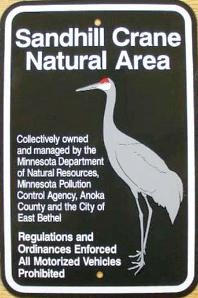
The Sandhill Crane Natural Area is named for the stately sandhill crane that graces lake shores. It is cooperatively managed by the City of East Bethel, Anoka County Parks, and two state agencies. This innovative approach to open space protection, marked by ecological information, has earned national awards.

The SCNA contains various wetland communities as well as prairie, oak savanna and oak forest. Wildlife found in the area includes bald eagles and Blanding’s turtles.

From a Humble Beginning. In 1993, East Bethel wished to acquire an 18-acre parcel from the Minnesota Department of Natural Resources on Deer Lake as a nature center or preserve. As East Bethel opened discussions it became apparent that many adjacent landowners were willing to consider preserving the unique natural features of the larger area cataloged in the Minnesota County Biological Survey.

The City formed a task force holding public open house events to permit residents to guide the establishment of the Natural Area and defined a vision statement for managing the ecologically significant 495-acre area to “protect and preserve the natural resources of the area, to provide appropriate recreational uses, and to encourage the involvement of adjacent landowners and area residents in participating in land conservation programs.

Sandhill Crane Natural Area Map

The process of reaching an agreement to establish plans and the cooperation of county and state agencies have led to a promise that this natural area will stay pretty much as it is. For adjacent landowner and SCNA Citizen Advisory Committee member Lorraine Bonin, the status quo is just fine. “We hear the sandhill cranes; it’s such a wild sound. There are loons here, and egrets. Walking once, in winter, I met a fox on the trail. However long it took to put this agreement together, it was worth it.”

For more information contact Jack Davis (East Bethel City Administrator) at 763-367-7850 and see the SCNA Case Study.

Fridley joins in making well sealing grants available

The City of Fridley has grants available to assist property owners with sealing unused wells. The grants provides 50% reimbursement of eligible costs (up to a total of $750) for contracted well sealing work. If you have a well and are interested in having this work done, please complete the application.

Cost-share grants available for a limited time. The cities of Blaine, Circle Pines, Fridley, Lexington and Lino Lakes have established a Well Sealing Cost Share Grant program for residents (and property owners) to have old wells sealed near a city well that supplies drinking water to the community. The grant is available to residents to seal unused wells before April 2016. Contact your city Wellhead Protection Manager to obtain a well sealing cost-share grant application:

See the Directory of Area Water Well Contractors to obtain bids to seal abandoned wells. For more information on well sealing go to the MDH Well Sealing webpage.

Disclosing wells during a sale or property transfer. When a home, farm, or other property is sold or transferred Minnesota Statutes, section 103I.235 requires the seller to disclose the number and the status of all wells on the property and provide a sketch map showing the location of each well. Often unused wells are sealed at that time. However a cost-share grant may not be available.

Is your property in a Drinking Water Supply Management Area? Go to the DWSMA Map to see if your property is close enough to a municipal drinking water supply well to be included in the City’s Drinking Water Supply Management Area.

The grants must be applied for; awarded; and used by April 2016, so please do not delay in applying.

Powered by WordPress