Free Family Festival – Confluence, Oct. 16th

Looking for a fun outdoor activity this month? Don’t want to travel too far? Check out this upcoming event!

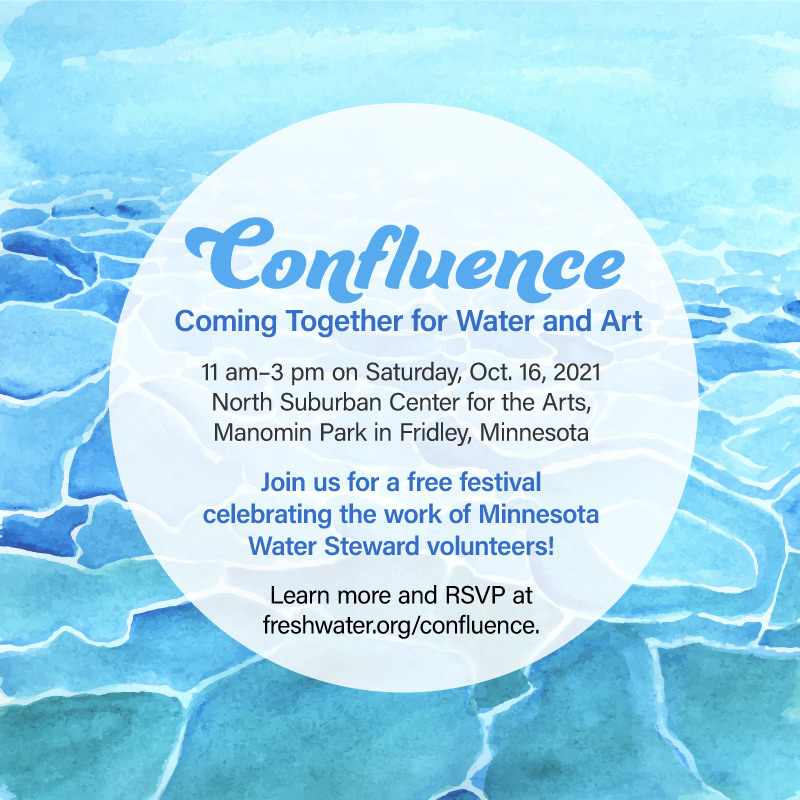
The public is invited to Confluence: Coming Together for Art and Water. Confluence is a celebration of work for water with art activities, a singalong, printmaking, an interpretive hike by the river, games for kids (and adults!), a food truck, art exhibits, art for sale, and more! Learn about Minnesota Water Stewards (MWS) and celebrate water with your community.

When: Saturday, Oct. 16th, 2021; 11 am – 3 pm

Where: North Suburban Center for the Arts, Manomin Park, Fridley (6666 E River Road)

What: This FREE festival celebrates the work of Minnesota Water Steward volunteers.

Who: Newly certified Stewards, seasoned Stewards, program partners, supporters, and the public are all welcome!

RSVP: The event organizer, Freshwater, requests an RSVP/registration. Click here and scroll down to enter your name and email to register.

The MWS program (formerly known as Master Water Stewards) trains and certifies community members who volunteer with watershed districts, cities, counties, and environmental groups to improve the health of our waters. Freshwater, a nonprofit inspiring and empowering people to value and preserve our freshwater resources, runs the program.

A cohort of the MWS program are artists who have created public art that educates and inspires awareness about water issues. This art ranges from a coloring book to decorated storm drains to art created from found objects—and more!

For more information, including a schedule of activities and details on getting to the event, visit the Confluence webpage here.

Also check out the Facebook event to see if your friends are going, or invite them to join you!
About Freshwater

Since 1968, Freshwater has been a leading public nonprofit organization dedicated to preserving freshwater resources and their surrounding watersheds. Its mission is to inspire and empower people to value and preserve our freshwater resources. Learn more at freshwater.org.
Upcoming Smart Salting Trainings

It’s fall in Minnesota, which means it is time to start thinking about preparing for the upcoming winter!

Those that take part in winter maintenance should look into Smart Salting trainings to learn practical winter maintenance while minimizing environmental impacts. This could be county, city, or state plow drivers; private winter maintenance staff and contractors; property managers; business owners; environmental professionals; and even environmental advocates.

MS4 permittees may wish to have their winter maintenance staff trained as a way to meet the new MS4 requirements aimed at reducing chloride pollution. The trainings touch on the new requirements and offer practical and technical information for better application and maintenance practices, salt storage, policy examples, and resources for community outreach.

Watch the Smart Salting Training for Winter Maintenance Professionals video to hear from maintenance pros that are now using less salt and still offering a high level of service!

See below for the Smart Salting Training classes taking place in October and November.

Smart Salting for Roads

Lean how to integrate science with practice winter maintenance on roads while minimizing impacts to the environment. Covers technical aspects such as application rates, calibration, using weather conditions to more accurately plan and apply, converting to de-icing and anti-icing, storage and more.

Who:

  • City, county, or state plow drivers
  • Private winter maintenance contractors and staff

When:

Smart Salting for Parking Lots & Sidewalks

Learn practical, more efficient winter maintenance practices for parking lots and sidewalks that can help save on costs and time while minimizing environmental impacts.

Who:

  • Hands-on public or private winter maintenance staff (e.g., staff at parks, hospitals, or colleges)
  • Those who hire or supervise winter maintenance staff
  • Private contractors

When:

Smart Salting for Property Management

Learn how to reduce damages caused by salt, that reducing salt use can save money while providing safe surfaces, ways to encourage your maintenance crew to use sustainable practices, address liability concerns, and the basics of snow and ice management tools.

Who:

  • Management-level property managers
  • Environmental professionals and advocates
  • Business owners
  • MS4 and Wastewater permit staff

When:

Visit the Minnesota Pollution Control Agency Smart Salting Training website for the training calendar and list of certificate holders.

Questions about the trainings? Email smartsalting.pca@state.mn.us.

2021 Virtual Metro Children’s Water Festival Available Now!

Calling all teachers, parents, and guardians! The 2021 Virtual Metro Children’s Water Festival is available now!

The Metro Children’s Water Festival is normally an in-person festival at the Minnesota State Fairgrounds, but the festival has been adapted to be virtual for 2021. There are a number of lessons and activities available that teach children about water resources and how young people can help ensure a future where both the quantity and quality of resources are protected and managed wisely.

Students can learn about wastewater treatment, water scarcity around the globe, and what lives in our waters. They can see a rainfall simulator, explore the Mississippi River, meet local water professionals, and study watersheds.

Content is available NOW! The festival week officially ends on October 1st, but all materials will be available throughout the entire 2021-2022 school year. Metro area teachers who register for the festival and watch any number of videos and complete the paired activities will receive an Every Kid Outdoors pass for each 4th grade student in their classroom, compliments of the U.S. Forest Service.

The festival is free and open to all, however curriculum is at a 4th grade level, and parks passes are available for 4th grade students only per the federal program.

Ready to get started?! Register at www.metrocwf.org/register and view the festival at www.metrocwf.org/festival.

The Metro Children’s Water Festival hopes your students and children all enjoy the 2021 virtual festival and the brand-new website!

Minnesota is Septic Smart – New SSTS Annual Report

The Minnesota Pollution Control Agency (MPCA) issued its latest subsurface sewage sewage treatment systems (SSTS) annual report just in time for SepticSmart Week.

The overall compliance rate of septic systems for 2020 is estimated to be 81% (505,300 systems), which is an increase from 77% in 2011. This exceeds the Clean Water Council’s strategic plan goal of 80% compliance. Systems failing to protect groundwater (FTPGW) and systems with an imminent threat to public health and safety (ITPHS) have both decreased over the last 10 years.

The SSTS annual report is compiled with information submitted by local government units (counties, cities, and townships) that administer installation permits and septic systems inspections. To learn more about the number of permits issued, inspections conducted, and septic system professionals licensed and certified in 2020, visit the MPCA’s SSTS annual report page.

Click here to read the full news release from the MPCA.

Septic Smart Week 2021 – Septic System Do’s and Don’ts

This week, September 20-25th, is SepticSmart Week! SepticSmart Week is an annual event in which the U.S. Environmental Protection Agency (EPA) designates a week that is focused on how homeowners and renters can care for and maintain their septic systems.

Many homes, as well as businesses, in Anoka County are served by septic systems. It is important that everyone knows how to properly care for their septic systems. Here are some Do’s and Don’ts for your septic system, provided by the EPA:

Protect It and Inspect It:

Do:

  • Have your system inspected (in general) every 3 years by a licensed contractor and have the tank pumped, when necessary, generally every 3 to 5 years.
  • (TIP: In Anoka County, septic systems are regulated by the cities and townships. Contact your city or township if you have questions about their requirements.)

Think at the Sink:

Don’t:

  • Pour cooking grease or oil down the sink or toilet.
  • Rinse coffee grounds into the sink.
  • Pour household chemicals down the sink or flush them.

Do:

  • Eliminate or limit the use of a garbage disposal.
  • Properly dispose of coffee grounds and good.
  • Put grease in a container to harden before discarding in the trash.

Don’t Overload the Commode:

Don’t:

  • Flush non-degradable products or chemicals, such as feminine hygiene products, condoms, dental floss, diapers, cigarette butts, cat litter, paper towels, pharmaceuticals.

Do:

  • Dispose of these items in the trash can!

Shield Your Field:

Don’t:

  • Park or drive on your drainfield. The weight can damage the drain lines.
  • Plant trees or shrubs too close to your drainfield – roots can grow into your system and clog it.

Do:

  • Consult a septic service professional to advise you on the proper distance for planting trees and shrubs, depending on your septic tank location.

Don’t Strain Your Drain:

Don’t:

  • Concentrate your water use by using your dishwasher, shower, washing machine, and toilet at the same time. All that extra water can really strain your septic system.

Do:

  • Stagger the use of water-generating appliances. This can be helpful especially if your system has not been pumped in a long time.
  • Become more water efficient by fixing plumbing leaks and consider installing bathroom and kitchen faucet aerators and water-efficient products.

Learn more about septic systems and how to be a SepticSmart homeowner here. If you experience a problem with your septic system, be sure to contact a licensed septic contractor right away. If you aren’t sure when your septic system was last pumped, most cities/township have this information on file, as they regulate septic systems in Anoka County.

North and East Metro Groundwater Management Area Update

The Minnesota Department of Natural Resources (DNR) has designated an area in the north and east portions of the metro region as the North & East Metro Groundwater Management Area (GWMA), which includes Washington and Ramsey counties, along with portions of Anoka and Hennepin counties. The Anoka County communities in the GWMA are Blaine, Centerville, Circle Pines, Columbia Heights, Columbus, Fridley, Hilltop, Lexington, Lino Lakes, and Spring Lake Park.

The North & East Metro Groundwater Management Area advisory team was established to provide ongoing insights to the DNR as it implements a five-year plan, approved in 2015. The plan will continue to guide the DNR’s approach to groundwater management in the north and east metro and provide a framework within which the DNR will work with water users to ensure that groundwater supplies remain adequate to meet human needs, while protecting lakes, streams, and wetlands.

The advisory team met in an online format on June 11, 2021. The agenda included:

  • A brief update on the status of the five-year plan for management of groundwater in the north and east metro area.
  • A summary of recent court proceedings.
  • An update on groundwater modeling and analysis.
  • Information on water conservation and efficiency efforts around the area.

In the status update, DNR project manager Dan Miller stated “The plan isn’t going to expire. We’re going to continue meeting with all of you and the advisory team”, as the GWMA Plan provided a framework for DNR work on local groundwater issues through 2020. The plan will continue to guide the DNR’s approach to groundwater management in the face of issues including population growth, groundwater quality concerns, and groundwater-surface water interactions.

Randall Doneen (DNR) highlighted some water conservation and efficiency trends. Per capita water use has been declining, in terms of residential use, as well as total community use. The Anoka County community of Fridley was highlighted, as they saved 28 million gallons using leak detection to help conserve water and save money.

Click here to read the full update bulletin from the DNR.

The advisory team will likely next meet in the fall of 2021. Be sure to subscribe to email updates to ensure you receive additional meeting details. A notice will be posted on Know the Flow as well. For more information on the GWMA, click here to view it’s website.

Public Hearing – Lower Rum River Watershed Management Plan

The Lower Rum River Watershed Management Organization (LRRWMO) Board of Managers will host a public hearing on the draft LRRWMO 2022-2031 Watershed Management Plan on Thursday, September 16, 2021 as part of the Board of Managers meeting. The hearing will start at 8:15 am, or shortly thereafter, at Anoka City Hall (2015 First Avenue, Anoka). Those wishing to attend virtually may do so using a the Microsoft Teams link posted at the LRRWMO website in advance of the meeting: www.lrrwmo.org.

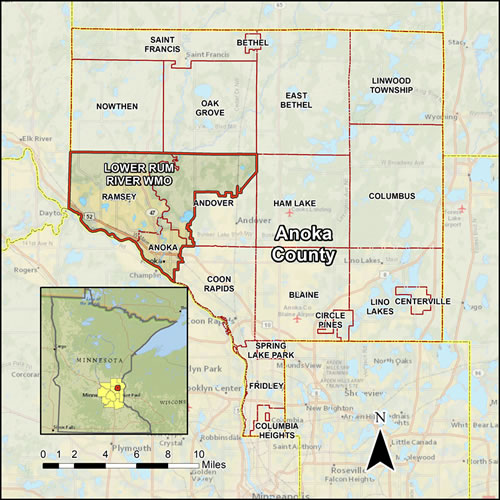
The LRRWMO is a joint powers special purpose unit of government including the cities of Ramsey, Anoka, and portions of Andover (see map at the end of this post). The Board is made up of representatives from each of these cities. This organization seeks to protect and improve lakes, rivers, streams, groundwater, and other water resources across municipal boundaries. All of the LRRWMO’s activities are guided by their Watershed Management Plan.

The draft LRRWMO 2022-2031 Watershed Management Plan was distributed for 60-day review as required in Minnesota Statutes 103B.231 from May 28-July 27, 2021. The draft Plan is currently available at the LRRWMO website. A summary of formal review comments and proposed responses to those comments will be made available at the LRRWMO website ahead of the public meeting.

The public hearing will include discussion of the Plan development process and responses to comments following the 60-day formal review. All are invited to attend the hearing and submit comments, written or verbal, that will become part of the official public hearing record. Please submit written comments electronically to the LRRWMO Engineer by September 15, 2021 at gwilliams@barr.com.

MDH Source Water Protection Grants

The Minnesota Department of Health (MDH) has two new grant opportunities that are now available. There are two different grants for different types of public water supply systems: one for community and nontransient noncommunity public water supply systems and one for transient noncommunity public water supply systems. The deadline for applications for both grants is 4:30 pm on September 30, 2021.

Plan Implementation Grant

  • Who: community and nontransient noncommunity public water supply systems who have an MDH-approved Wellhead Protection Plan or MDH-endorsed surface water intake protection plan
  • Purpose: to help public water suppliers implement source water protection measures included in their MDH-approved or -endorsed plan.
  • Cost share: not required
  • Amount: $1,000 to $10,000
  • Website to download an application form and to review more detailed information about the grant program: Plan Implementation Grant

Noncommunity Transient Grant

  • Who: noncommunity transient public water systems
  • Purpose: to support measures that address a potential contamination source that presents a high risk to a source of drinking water as determined by MDH
  • Cost share: an equal cost share is required for receiving this grant
  • Amount: $250-$10,000
  • Website to download an application form and to review more detailed information about the grant program: Noncommunity Transient Grant

2021 Metro Children’s Water Festival

SAVE THE DATE for a fun-filled virtual festival sharing presentations and activities about our most precious resource – water!

The Metro Children’s Water Festival will host a virtual water festival beginning the week of September 27th and it will be available throughout the 2021-2022 school year. Virtual lessons consist of videos on downloadable curriculum and cover many topics including the following:

  • What happens to wastewater from our homes in Waste water treatment for kids
  • How different land covers affect how much rain soaks into the ground or runs off in Rainfall simulator
  • What happened to the waterfall in the Twin Cities in the Mystery of the Disappearing Waterfall
  • How do streams pick their path and what creatures are found in them in A model stream
  • Water scarcity around the world and what you can do to help in Youth help solve the global water crisis
  • What small aquatic bugs called macroinvertebrates can tell you about the health of your local lakes and streams in Exploring macroinvertebrates and water quality

The festival website is currently under construction and will be available in early September. Fill out the form on the home page to be sent a reminder when the virtual festival is available, or feel free to check the Metro Children’s Water Festival website in early September.

Also, check out the festival’s BRAND NEW logo below!

Fall/Winter 2021 Well Water Testing

The Anoka County Public Health and Environmental Services Department helps Anoka County residents protect their drinking water. One way to assure safe, quality drinking water is by having it tested. It is recommended to test for bacteria and nitrate on an annual basis.

The Anoka County Well Water Testing program will continue to operate on a limited basis through the reminder of 2021. In addition to the sanitary analysis (bacteria and nitrate), samples for arsenic and manganese will continue to be accepted. Please see below for full details.

Water samples for sanitary analysis (bacteria and nitrate), arsenic, and manganese will be accepted on the dates below with limited hours. Water samples for other analyses (lead, iron, etc.) will not be accepted at this time. An appointment and pre-payment over the phone will be required. Please continue reading for full details. The upcoming dates and times for water sample drop-off will be:

  • Monday, September 27th, 1-4 pm
  • Tuesday, September 28th, 9-11:30 am
  • Monday, October 25th, 1-4 pm
  • Tuesday, October 26th, 9-11:30 am
  • Monday, November 22nd, 1-4 pm
  • Tuesday, November 23rd, 9-11:30 am
  • Monday, December 20th, 1-4 pm
  • Tuesday, December 21st, 9-11:30 am

Please note that while drop-off dates are typically the last Monday and Tuesday of the month, November and December are the second to last Monday and Tuesday of the month due to the holidays.

The drop-off table will be located on the 1st floor of the Anoka County Government Center near the main door.

Below are the criteria for dropping off a sample:

  1. Test kits (sample collection bottle and blue (for sanitary analysis) or yellow (for arsenic or manganese) sampling sheet with collection instructions) must be obtained ahead of time. No kits will be available on the drop-off days. Test kit pick-up locations are listed below.
  2. A drop-off appointment must be made by calling ahead and paying in advance with a credit card over the phone. No cash or checks allowed, and no credit cards will be accepted the day of drop-off. Call (763) 324-4260 to make an appointment and pay.
  3. The blue or yellow sampling sheet must be completed ahead of time. No pens will be available to use at the drop-off table.
  4. Specific water-related questions can be directed ahead of time to Abby Shea at (763) 324-4207.
  5. Only samples for sanitary analysis (bacteria and nitrate), arsenic, and manganese will be accepted at this time. If other testing is desired, it can be performed at a later date or a private laboratory can be recommended.
  6. Samples for sanitary analysis (bacteria and nitrate) must be collected as close to the drop-off time as possible to avoid exceeding the holding time of the sample, which can result in inaccurate results.
  7. Social distancing guidelines must be respected, and rules of the drop-off area must be followed.

Water test kits for sanitary analysis (bacteria and nitrate) are currently available at the following locations:

  • Andover City Hall *
  • Blaine City Hall
  • Blaine Public Works (1801 101st Ave NE, Blaine; (763) 785-6165 – please call ahead)
  • Centerville City Hall
  • Columbus City Hall
  • East Bethel City Hall *
  • Ham Lake City Hall
  • Lino Lakes City Hall **
  • Linwood Township Hall
  • Nowthen City Hall
  • Oak Grove City Hall *
  • Ramsey City Hall **
  • St. Francis City Hall

*Denotes location with arsenic test kits in addition to sanitary analysis test kits.

**Denotes location with manganese test kits in addition to sanitary analysis test kits.

Powered by WordPress