St. Francis joins other communities to protect groundwater and drinking water

St. Francis has it all with friendly neighborhoods surrounded by scenic rural lands plus clean water that runs down the Rum River – and the groundwater below. The St. Francis City Council resolved to efficiently protect their drinking water supply (groundwater) by cooperating with other communities to implement wellhead protection. Wellhead protection keeps groundwater and wells from being polluted.

The Anoka County Municipal Wellhead Protection Group welcomed St. Francis Public Works, at their August 20th meeting, making St. Francis the tenth municipal partner to cooperate in protecting the groundwater source of the City’s drinking water with Andover, Anoka, Blaine, Centerville, Circle Pines, Fridley, Lexington, Lino Lakes and Spring Lake Park. Anoka County Environmental Services and the Minnesota Department of Health have joined the Municipal Wellhead Protection Group to keep community water supplies safe from pollution.

Residents and property owners have their part in protecting the source of their drinking water. If not managed properly, home and business chemicals and wastes may also pollute groundwater. Here are ways St. Francis residents can help:

  • Find out if you are in a Drinking Water Protection Area (interactive map)
  • Dispose of household hazardous waste at the Anoka Co drop-off facility (brochure)
  • Seal unused wells using a licensed professional (Video, YouTube 4:36)
  • Maintain your septic system in good working order (brochure)
  • Learn how your family can use water wisely (EPA WaterSense website)

The St. Francis Drinking Water Report  summarizes the water tests performed in 2013 showing that your drinking water meets federal Safe Drinking Water Standards. Do your part to protect the City’s drinking water supply. For more information contact St. Francis Public Works at 763-233-5200.

Attention St. Francis private well owners. The City wants your drinking water to be safe too. You are encouraged to perform an annual water test (kits are available at City Hall) and maintain your home well in good condition (see the Well Owner’s Handbook) .


Citizen survey for community development

What’s important to you? Anoka County is asking citizens, cities, non-profits, and businesses to rate specific priorities, as related to low- to moderate-income individuals by taking the Citizen Survey. Anoka County Community Development needs your help in preparing their five-year Consolidated Plan.

The Consolidated Plan describes the housing needs of low- and moderate-income residents, outlining strategies to meet those needs and listing all resources available to implement the strategies. The needs listed in the survey include water and environmental health issues including:

  • Neighborhood cleanup
  • Asbestos removal
  • Screening for lead poisoning
  • Cleanup of contaminated sites
  • Water and sewer improvement
  • Tree planting
  • Flood drainage improvement

Responses to the online survey can be submitted until September 12, 2014. For more information contact Anoka County Community Development at 763-323-5764.

Household hazardous waste collection events

Anoka County Integrated Waste Management makes it easier for residents to properly dispose of their household hazardous wastes and reduce pollution of our water resources. In addition to the year-round operation of the Household Hazardous Waste Facility in Blaine, residents may use the Household Hazardous Waste Collection Events held at the Anoka County Fairgrounds in Anoka.

The Household Hazardous Waste Collection Events 2014 are held 9:00 am to 1:00 pm:

  • Every Tuesday (August 5th through October 14th) and
  • Saturdays (August 16th, Sept. 13th, Oct. 4th and 18th)

Examples of what to bring include: leftover paint, household cleaners, fluorescent bulbs, automotive fluids, and most household products labeled Caution, Warning, Danger, or Poison.  Please be careful to secure products so they don’t tip over or leak in your car.

What NOT to bring: ammunition or explosives, appliances, asbestos, batteries, electronics, garbage, medications, medical sharps (needles/syringes) and tires. Integrated Waste Management can provide information on how to properly and safely dispose of these items. 

For more information contact Anoka County Integrated Waste Management at 763-323-5730 or use the CONTACT webpage.

Businesses may need to apply for an industrial stormwater permit

To prevent pollution from reaching ditches, streams, lakes and rivers the Minnesota Pollution Control Agency reminds manufacturing, recycling, transportation or other industrial businesses to apply for an industrial stormwater permit before the October 5th deadlineStormwater management helps facilities prevent, reduce or control pollution of surface and groundwater by restricting contact between pollutants and industrial equipment, machinery, raw materials, products, waste-handling equipment and wastes.

Industries, ranging from timber products to chemical manufacturing, scrap recycling, landfills, air transportation and salvage yards must be permitted where stormwater may come into contact with industrial activities or wastes. Currently permittees (202 in Anoka County) must re-apply before October 5, 2014. Other businesses learn whether they need a permit by going to the Industrial Stormwater Permit information website.  Current permittees are listed on the Industrial Stormwater permit database.

For more information contact the MPCA Stormwater program staff at 651-757-2119. The penalty for late applications, or failure to apply, is $400.

Become a Minnesota Master Naturalist Volunteer

Discover the wonders of our natural resources and lead others by becoming a Minnesota Master Naturalist.

Who can become a Minnesota Master Naturalist? Any adult who is curious and enjoys learning about the natural world, shares that knowledge with others, and supports conservation. If you enjoy hiking, bird watching, following tracks, or identifying wildflowers, you’ll love being a Minnesota Master Naturalist Volunteer.

The Minnesota Master Naturalist training courses consists of in-classroom training and field trips. Courses are designed to be a general overview of Minnesota’s three biomes: Big Woods, Big Rivers (BWBR); Prairies and Potholes (PP); North Woods, Great Lakes (NWGL); plus advanced training (ADV). The courses locally available are:

Focusing on Nature Through Art and Writing ($330 class description) at Wargo Nature Center, Lino Lakes. Come and learn about the Big Woods Big Rivers Biome during the day, and expand your artistic skills and abilities in the evening with three local Master Naturalist instructors, and artists. Three weekends (starting Sept. 27th) of creative learning take you canoeing on the Mississippi, on a hike and a hayride. Optional Saturday evening activities feature journaling, drawing, creative writing and painting.

Prairies and Potholes ($200 class description) at the Kroening Interpretive Center, Minneapolis. On an acre of prairie, there may be a million plant-eating animals! Prairies once covered a third of Minnesota, yet is a highly endangered biome. Join us to learn the plants, animals, geology, and history of the prairie and pothole region. Each class will spend considerable time outdoors exploring our park’s prairie, and our two field trips will take us into the heart of the prairie as we investigate the diversity of these amazing grasslands around the state. This class is held Wednesday mornings  (Sept. 3rd to Nov. 19th) from 9:30-Noon; field trips will be all day on September 20th and October 5th. A capstone project is required as a component of class completion. Instructors will help guide this process. 

Native Plant Community Field Guide Training ($20 class description) The Minnesota Department of Natural Resources and the University of Minnesota are partnering to offer training in the use of the DNR Field Guides to the Native Plant Communities of Minnesota. This two-day course (Sept. 22 & 23, 2014) provides information about how to use the field guides, incorporates practice exercises, and explores how the information gained from using this process has been applied in resource management planning. The course is conducted at Cedar Creek Ecosystem Science Reserve in East Bethel, a 5400-acre research station in the deciduous biome and home to over 23 different plant communities. Day 1 is an indoor training to the guides and Day 2 is the field session.

If the course cost is a hardship, please fill out a scholarship application.

Water quality – what’s most important to you?

Minnesotans admit that they don’t know everything about water pollution. They may not know how pollutants are finding their way into rivers, lakes, streams, and groundwater,  But, in a recent survey, reported in the StarTribune, Minnesotans know what their three top water quality concerns are:

  • Clean water for consumption of fish
  • Clean water for drinking
  • Clean water for swimming

Fishing. Anoka County is in the heart of the land of 10,000 lakes and great fishing. However, pollution that finds its way into our waters can affect the safety of the fish that we eat. All the fish in Anoka County lakes and rivers are safe to eat. However, too much of certain fish from certain lakes or streams may not be healthy. The Minnesota Department of Health (MDH) has surveyed fish throughout the state and provide guidelines for the consumption of fish. Go to the MDH fish consumption advice webpage for more information.  

Drinking Water. The protection of drinking water is accomplished in two parts. First the owner of the water supply must test the water regularly to make sure it is, and remains, safe to drink. Public water suppliers provide annually water quality reports to residents. Private well owners (home and cabin wells) should annually test their water to be certain that it remains safe. Anoka County Environmental Services provides water testing services for private well owners.

Second, drinking water protection is achieved by preventing groundwater pollution near the well. Public water suppliers are implementing wellhead protection programs to prevent groundwater pollution near city wells. Private well owners should keep pollutants away from their well too. See the Well Owners Handbook for more information on protecting and testing private wells.

Swimming. Public pools and swimming beaches are monitored by Anoka County Environmental Services and County or City parks departments. If the water becomes unsafe for swimming – the pool or beach is closed. Keeping pollution out of lakes and streams is a huge challenge requiring everyone’s cooperation. Water that runs off land onto streets, storm sewers and ditches eventually end up in streams, rivers and lakes. Lake property owners make a big difference in water quality by using Shoreland Best Management Practices to reduce pollution and protect their lake.

To learn more about how you can reduce pollution and protect our water resources go to the Anoka County Integrated Waste Management webpage or contact your City’s stormwater pollution prevention specialist.

Water Resources GIS application receives national honors

Anoka County received the “Best of Category” award for their Water Resources GIS (Geographic Information System) computer application by the National Association of Counties (NACo). “These recognitions honor the power of innovation in the hands of our employees,” said Anoka County Board of Commissioners Chair Rhonda Sivarajah. “Their time, talent, and ideas allow us to achieve our mission every day to serve citizens in a respectful, innovative and fiscally responsible manner.

The Anoka County Water Resources GIS Application makes aerial photos and information about the county’s wetlands, ditches, soils, flood zones, culverts, land ownership, and watercourses accessible electronically. The project required the scanning of more than 5,000 historical ditch records, including ditch profiles, maps, correspondence, and legal documents. The water resources information provides a one-stop shop for citizens, businesses, and government agencies to conduct ditch research, all without having to contact the county.

Future plans are to incorporate private and non-county ditch data into the application.

Andover is protecting its drinking water

The Andover City Council believes that its residents deserve the best that the City has to offer.  The future of Andover’s water supply is the groundwater below its homes and businesses. The City is committed to providing sustainable and safe drinking water to residents now and in the future.

On July 15, 2014, Andover Public Works joined the Anoka County Municipal Wellhead Protection Group to cooperate in protecting the source of the City’s drinking water with the cities of Anoka, Blaine, Centerville, Circle Pines, Fridley, Lexington, Lino Lakes and Spring Lake Park. Wellhead protection keeps groundwater and wells from being polluted. Anoka County Environmental Services and the Minnesota Department of Health have joined the Municipal Wellhead Protection Group to keep community water supplies safe.

Residents and property owners have their part in protecting the source of the City’s drinking water. Factories and landfills are regulated to keep them from polluting our natural resources. However, homes and businesses may also be a source of groundwater pollution. No one wants to be the source of the problem. Here are ways Andover residents can be part of the solution:

Andover residents and businesses are encouraged to do their part in the protection of the City’s drinking water supply. For more information contact Andover Public Works at 763-767-5180. The Andover Consumer Confidence Report summarizes the tests performed in 2013 showing that the drinking water meets federal Safe Drinking Water Standards.

Attention Andover private well owners. The City wants your drinking water to be safe too. You are encouraged to perform an annual water test (kits are available at City Hall) and maintain your home well in good condition (see the Well Owner’s Handbook).

Hot weather can bring algal blooms to lakes and ponds

When the summer sun shines and temperatures climb, conditions are ripe for Minnesota lakes to produce harmful algal blooms. Most algae are harmless, but under the right conditions, certain types of algae can pose health risks. People or animals may become sick if they come into contact with or ingest affected water. In extreme cases, dogs and other animals have died after exposure to lake water containing toxic blue-green algae.

High rainfall results in nutrient-rich runoff entering our lakes, which fuels algae growth. As sunlight increases and temperatures warm, we can anticipate blooms of blue-green algae on many of our lakes,” said Minnesota Pollution Control Agency (MPCA) lakes expert Steve Heiskary.

There are many types of blue-green algae found everywhere, but thrive particularly in warm, shallow, nutrient-rich lakes and ponds. Often blown toward downwind shorelines, it is under these conditions that humans and animals come in contact with blue-green algae and where the risk of algal toxins is greatest.

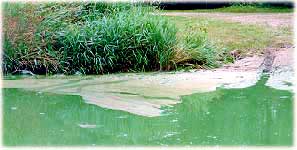
Not all blue-green algae are toxic, and there is no visual way to predict whether a blue-green algal bloom contains toxins harmful to humans or animals. But harmful blooms are sometimes said to look like pea soup, green paint, or floating mats of scum, and they often have a bad odor. “You don’t have to be an expert to recognize an algae bloom that might be harmful,” Heiskary said. “If it looks bad and smells bad, don’t take a chance. Stay out, and keep children and pets away from the water until the bloom subsides.

For more information about harmful algae blooms see the MPCA Blue Green Algae fact sheet or call the MPCA at 651-296-6300.

If experiencing health effects, contact a medical professional. In addition, people are encouraged to report human health effects to the Minnesota Department of Health (MDH) Foodborne Illness Hotline (monitors all disease outbreaks) at 1-877-366-3455. For health questions, citizens can contact MDH’s Acute Disease Investigation and Control group at 651-201-5414 or visit the MDH’s Blue-green Algal Bloom web page.

Lake George Improvement District Annual Membership Meeting (Aug. 5th)

The Lake George Improvement District (LGID) Annual Membership Meeting will be held at 7:00 p.m. on Tuesday, August 5, 2014 at the Oak Grove City Hall.  All Lake George residents and property owners are encouraged to attend to be part of decisions that affect Lake George and shore-land property values.

The LGID is charged with overseeing the wellbeing of Lake George by preserving and protecting lake waters.  One of the major functions is to monitor and control the spread of Eurasian Water Milfoil and Curly Leaf Pondweed.  But other issues affecting the quality and usability of the lake may also be addressed.

The business items for the Annual Meeting include:

  1. Approval of the LGID budget (property assessments) for 2015;
  2. Approval of expenditures over $5,000; and
  3. Elect two members to the Board of Directors.

Lake George Improvement District residents and property owners may place their name into nomination as a candidate for Director by sending a letter of interest (form) to the LGID (Lake George Improvement District, PO Box 425, St. Francis, MN 55070).  Director candidates must be: 18 years of age or older; own property abutting Lake George or with direct access to the lake; and mail a letter of interest to the LGID postmarked on or before July 15, 2014. Or deliver your letter of interest to the LGID Board and get more information at their July 15th meeting (7:00 pm at the Oak Grove City Hall).  There will be two Directors elected at the Annual Meeting.

Powered by WordPress