Dwindling groundwater reserves – learning from the California experience

Dr. Jay Famiglietti, is a University of California, Irvine, professor and leader in worldwide research using NASA satellites to measure changes in the Earth’s stores of groundwater. Recently, Dr. Famiglietti visited the University of Minnesota to present the findings of his research titled Dwindling Groundwater Reserves as Viewed from Space (UofM video, 1:40:52) including discussion with Minnesota water experts. Dr. Famiglietti was interviewed on 60 Minutes (Nov. 16th) about Depleting The Water (CBS News video, 13:55)

NASA Groundwater Image (Famigliette)

In September 2014, California passed legislation to manage groundwater and address a prolonged drought where water resources are being depleted by increasing use. The Minnesota legislature created groundwater management areas as a tool for the Minnesota Department of Natural Resources (DNR) to address difficult groundwater-related resource challenges.

In 2012, the DNR established the North and East Metro Groundwater Management Area (N&E GWMA) to address the impacts of groundwater pumping on water resources and dropping lake levels, including White Bear Lake. The N&E GWMA includes all of Ramsey and Washington Counties, the city of Minneapolis (east of the Mississippi River) and ten cities in Anoka County (Blaine, Centerville, Circles Pines, Columbia Heights, Columbus, Fridley, Hilltop, Lexington, Lino Lakes and Spring Lake Park).

A groundwater management plan for the N&E GWMA is expected to be completed early in 2015. For more information and to receive updates, go to the DNR’s N&E GWMA webpage.
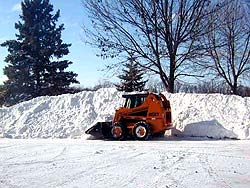
Parking lot snow being removed (MPCA photo)

Winter maintenance choices for clean water

Water pollution from salt (or chloride) is widespread in metropolitan areas of the upper midwest. The majority comes from salt de-icers used for winter maintenance of roads, parking lots, driveways and sidewalks. Education and Training can reduce pollution of water resources by applying deicing chemicals effectively to remove ice while minimizing pollution of our water resources.

FOR HOMEOWNERS: View Improved Winter Maintenance: Good Choices for Clean Water video (YouTube; 15:05). Choose and use tools and deicers to keep driveways and sidewalks safe this winter while preventing harm to our rivers, lakes, streams and groundwater.

FOR ROAD AND COMMERCIAL MAINTENANCE COMPANIES: The Mississippi Watershed Management Organization is sponsoring Winter Maintenance for Sidewalks & Parking Lots workshops on Dec. 9, 2014 and on Jan. 15, 2015.

  • Who should attend? Private contractors and service providers, public works staff, property managers, distributors, snowplow drivers, crew leaders, supervisors, permanent and seasonal employees.
  • Training topics include: Application rates, storing materials, how to calibrate equipment, weather conditions, de-icing and anti-icing, environmental effects, and new maintenance methods.
  • Voluntary certification in Snow and Ice Control Best Management Practices – Level 1.
  • Training is free, paid for by the Clean Water Act, Section 319 Nonpoint Source Management Fund and the MWMO. Lunch will be provided.
  • Winter Parking Lot and Sidewalk Maintenance Manual may be used as a reference document at the training sessions.

Winter Maintenance for Small Sites (YouTube; 19:34). For seasonal employees, business owners, front desk staff to safely control snow and ice on steps, ramps, entryways and curbcuts while reducing the amount of salt entering our rivers and lakes.

Financial assistance available for repairing private wells and septic

The Anoka County Community Development Department has partnered with the Minnesota Department of Agriculture to bring low interest loans to land owners in Anoka County for repair or replacement of failing home well or septic systems. The Agricultural Best Management Practices (AgBMP) program purpose is to encourage practices that improve water quality.

The AgBMP Loan Program is funded by the Minnesota State Legislature, the Minnesota Public Facilities Authority, and the U.S. Environmental Protection Agency and is administered through the Minnesota Department of Agriculture.

Since the program’s start up in August, 2014, the county has improved 14 properties and has authorized expenditures just over $200,000.00 to improve well and septic systems within the county. The loans are repaid over a five or ten year period via a special assessment on the land owner’s property tax.

Additional funding has been made available to counties willing to participate in this program. Interested land owners can find more information and application materials on the Anoka County Agricultural Best Management Practices webpage.

For more information, contact Barb McKusick at 763-323-5722.

Guidelines for drinking water protection at seasonal establishments

As the temperature drops people move inside leaving cabins, golf courses, water parks and baseball diamonds empty until spring. It also means closing up seasonal wells and water dispensers at parks, campgrounds, golf courses and outdoor catered events.

Anoka County Community Health and Environmental Services Department encourages operators of seasonal water well systems and on-site water dispensers to properly close wells and store dispensers by following the Department guidelines:

Guidelines for Opening & Closing Seasonal Well Water Systems

Guidelines for Drinking Water Dispensers

For more information call 763-422-7063.

America recycles day (Nov. 15th)

PlasticBottle-PETHey everyone, I’m a bottle.

There’s lots of bottles like me out there. Some of us are plastic, some are glass. And let me tell you a little secret, we don’t always get along with each other! The glass guys are like all “hey, I’m all shiny and fancy” especially those French wine bottles… but then the plastic ones are all “hey, we’re lightweight and fit in your cup holder.”

Did you know that by recycling me I can become an Anoka County park bench or fiber for a new Andover High School sweatshirt? It’s true! Recycling gives products new life and saves energy, creates jobs and… hey… who wants to spend eternity in a landfill?

Join all of us bottles on November 15th in celebrating America Recycles Day. But don’t stop with just one day. Recycle EVERY day. Because once I get recycled, there are a lot of other bottles, cans, newspapers, mobile phones and other things that are counting on you to give your garbage a new and useful life.

MnTAP Water Conservation Project for Business and Industry

Water conservation not only helps to preserve an important natural resource – it’s good business. NOW there is an opportunity to have a engineering intern help a business conserve water as it improves efficiency and reduces operating costs.

Your company may be paying twice for the water it uses. First, to purchase the water coming into your facility. Then, the water leaving your facility to a wastewater treatment plant. Exposing these costs helps a company to better understand an often overlooked expense.

The Minnesota Technical Assistance Program (MnTAP) located at the University of Minnesota has announced the launch of a project to identify water conservation opportunities. The project focuses on industries in the North and East Metro Groundwater Management Area. This area was established by the Department of Natural Resources in need of attention for maintaining sustainable water supplies. The MnTAP project includes:

  • Identification of industrial water users
  • Outreach and awareness raising of the importance of water conservation, including a frequent electronic newsletter with tips for best practices and presentations to area organizations
  • Assessments of industrial site water use with recommendations for improvement by MnTAP staff members

Water conservation has received significant attention from agency, public, and media sources in recent years., This project will focus on water conservation solutions to maintain sustainable supplies of clean water for all users. A MnTAP water conservation project at Federal Cartridge Company in Anoka resulted in 10% reduction in annual total plant wastewater discharge and a total savings of $22,300 per year (see factsheet).

Your business may be able to address water conservation and energy efficiency sooner with the help of a MnTAP intern. An intern can make suggestions that improve efficiency, save money, reduce waste, and decrease regulatory compliance burden. Also, an intern has the time and creativity to research alternative equipment, procedures, chemicals, and raw materials.

If you are interested in getting involved in this water conservation project (at  no cost to your business) contact Mick Jost (MnTAP Program Coordinator) at 612-624-4694.

The buzz on pesticides

We are experiencing an alarming reduction in our bee population with increased use of pesticides in agricultural and urban areas. How and why bees are declining isn’t fully understood, which is more alarming.

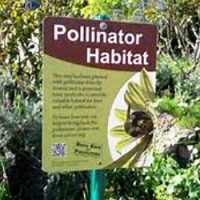
Bees are pollinators – a part of the cycle of life. Pollination is the transfer of pollen from one part of a flower to another, resulting in the production of seeds. Seeds needed to begin the next harvest. Now more than ever, it is critical to promote practices that will benefit pollinators by providing habitats free of excessive pesticides, full of nectar and pollen resources.

PLUS, the safe use of pesticides will improve our water resources that have been found to contain pesticides. Like bees, our water resources are part of the cycle of life. To learn more:

Hazardous waste workshop for Large Quanitity Generators (Dec. 9, 2014)

Cooperation of business and industry is an important part of Anoka County’s pollution prevention program. By meeting the standards of safe disposal – commercial hazardous waste is managed at companies to prevent it from polluting of our natural resources.

Anoka County Environmental Services is offering a Large Quantity Hazardous Waste Generator workshop for business and industry on Tuesday, December 9, 2014. Registration is required. This workshop will present the latest techniques and standards to manage their waste and comply with state standards. The workshop (see brochure) includes:

  • Basic requirements (license, container management, manifests and record keeping)
  • LQG requirements (emergency response, contingency plan and personnel training)
  • Recyclable fuels (John Pollock, WCIC Industrial Services)
  • Recycling assistance for businesses (Amy Ulbricht, Anoka County Integrated Waste)
  • Wellhead protection and stormwater pollution prevention (Jim Hafner, City of Blaine), PLUS
  • Water conservation (Mick Jost, MnTAP)

To register contact Elizabeth Lyons (763-422-7071) or Kathy Piela (763-422-7093).

ATTENTION RESIDENTS: Many chemicals used at a business are sold to residents and homeowners at stores. It is estimated that the collective volume of household hazardous waste is greater than that generated at businesses. Anoka County encourages residents to safely dispose of their hazardous waste at the Household Hazardous Waste Facility. For more information for residents call Anoka County Integrated Waste at 763-323-5730.

Arsenic testing is recommended for private wells

One of every five homes in Anoka County get their drinking water from a private well. Arsenic is found in groundwater throughout Minnesota. In a Minnesota Department of Health (MDH) program to monitor the water quality of newly constructed wells, 8.7% of private (home/cabin) wells in Anoka County exceeded the safe drinking water level for arsenic.

Exposure to arsenic can have serious adverse health effects, so it’s important to test all private wells for arsenic and take steps to reduce high arsenic levels. The the recommended maximum concentration of arsenic in drinking water is below 10 micrograms per liter (ug/L). The arsenic concentration of a private well should be checked once to determine if it is found at all.  If a high level of arsenic is found the well owner may take actions to limit their exposure and protect their family’s health.

Anoka County Environmental Services provides services to residents to test their private well for many contaminants including arsenic.  To learn more about arsenic in drinking water go to the MDH Arsenic webpage. For information on testing your private wells call Environmental Services at 763-422-7063.

Sunrise River WRAPS report available for comment

East Bethel and Linwood communities are inside the Sunrise River Watershed. Residents on Sunrise River (including Coon, Typo, Martin and Linwood lakes) know that the quality of these water-bodies depend on proper management of the land that surrounds them (the watershed).

The Sunrise River Watershed spans throughout the counties of Anoka, Chisago, Isanti, and Washington as it collects precipitation and flows to the St. Croix River. The watershed is approximately 381 square miles in extent, and includes 33 cities and townships. The Sunrise watershed has 12 lakes and 10 streams with one or more impairments related to eutrophication (lakes), low dissolved oxygen, turbidity, pH, and fish and macro-invertebrate impairments (Impaired Waters List, link).

The Sunrise River Watershed Restoration and Protection Strategy (WRAPS) Report is available for public review and comment through Monday, Nov. 19. The Report recommends action to restore several water bodies in the watershed and protect those in good health.

For more information contact Christopher Klucas (Minnesota Pollution Control Agency, 520 Lafayette Road, St. Paul, Minnesota 55155; 651-757-2498; christopher.klucas@state.mn.us). TTY users may call the MPCA teletypewriter at 651-282-5332 or 800-657-3864.

Powered by WordPress